


Jurnal Abdi Inovatif: Pengabdian kepada Masyarakat (JAI) is committed to ensuring the quality, originality, relevance, and scientific integrity of all published articles through a rigorous, fair, confidential, and transparent peer review process.
Every submitted manuscript undergoes an initial editorial assessment to determine whether it:
Manuscripts are screened using similarity-detection software. Similarity reports are evaluated by the editorial team. A similarity score alone does not constitute a determination of plagiarism.
Manuscripts that do not meet the journal's basic requirements may be rejected without external peer review (desk rejection).
JAI uses a double-blind peer review system. Reviewers do not know the identity of the authors, and authors do not know the identity of the reviewers.
Manuscripts that pass the initial editorial screening are assigned to a handling editor and evaluated by at least two independent external reviewers with relevant expertise.
Reviewers are selected based on:
Reviewers must not have a personal, professional, institutional, financial, or collaborative relationship with the authors that could compromise the objectivity of the review.
The handling editor does not act as a reviewer for the same manuscript.
Authors are not required to nominate reviewers, and reviewer selection is conducted independently by the Editorial Office.
Reviewers evaluate manuscripts based on:
Based on the reviewers' recommendations and the overall editorial assessment, the manuscript may receive one of the following decisions:
The final editorial decision is made by the Editor-in-Chief or a designated handling editor authorized by the Editor-in-Chief, based on the reviewers' recommendations, the revised manuscript, and the journal's editorial policies.
A positive reviewer recommendation does not automatically guarantee acceptance.
Authors receiving a revision request must submit:
Revised manuscripts may be returned to the original reviewers for further evaluation when necessary. More than one round of revision may be required.
All manuscripts submitted to JAI are treated as confidential documents. Reviewers must not disclose, distribute, discuss, copy, or use unpublished information contained in a manuscript for personal, professional, or research purposes without written permission from the Editor.
Editors and reviewers must disclose and avoid any potential conflict of interest.
Editors and reviewers must decline to handle manuscripts involving:
If a conflict of interest is identified during the review process, the manuscript will be reassigned to another qualified editor or reviewer.
The peer review process normally takes approximately 4–8 weeks, depending on reviewer availability, manuscript complexity, and the number of revision rounds.
This timeframe is indicative and does not constitute a guarantee of acceptance or publication.
Jurnal Abdi Inovatif currently does not publish special issues.
If special issues are introduced in the future, all manuscripts will be subject to the same editorial standards and independent external peer review procedures as regular submissions. The Editor-in-Chief will retain overall responsibility for the editorial quality and integrity of all special issue content.
Authors who wish to appeal an editorial decision should follow the procedures described in the journal's Complaints and Appeals Policy. Appeals must provide clear and substantive reasons for reconsideration and will be handled independently and fairly.
Manuscript Submission → Administrative Check → Initial Editorial Screening → Similarity Check → Desk Evaluation → Assignment to Handling Editor → Double-Blind Peer Review by at Least Two Independent Reviewers → Editorial Decision → Author Revision → Final Acceptance → Copyediting → Layout Editing → Proofreading and Author Approval → DOI Registration → Online Publication
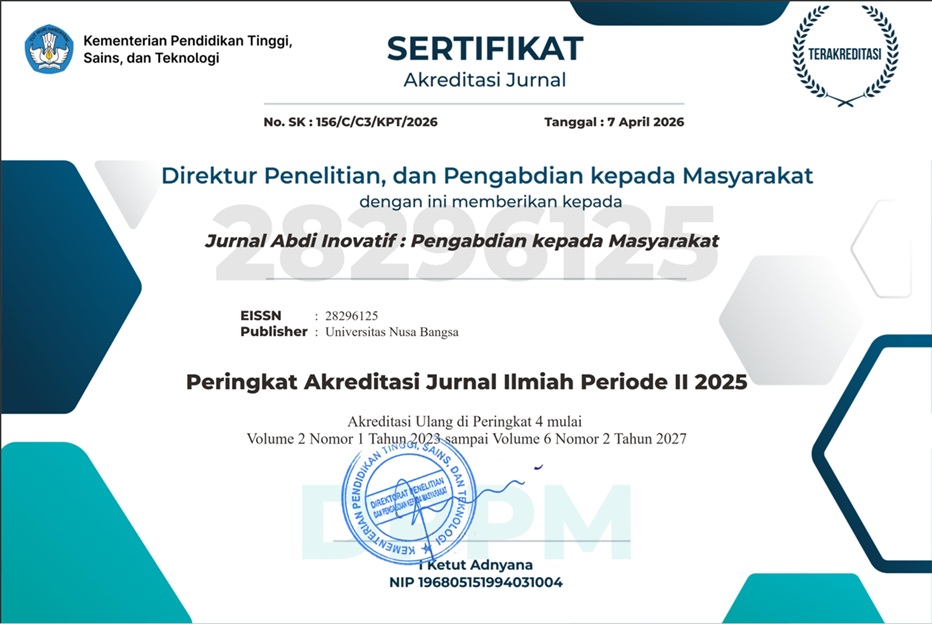


Published by Universitas Nusa Bangsa
Managed by Universitas Nusa Bangsa
Address Jln. KH. Sholeh Iskandar Km.4, Tanah Sareal, Bogor - Jawa Barat 16166